The platform
The workflow, as the specimen travels.
From a paper referral in a waiting room to a receipted specimen at the lab door, with every step captured as evidence.
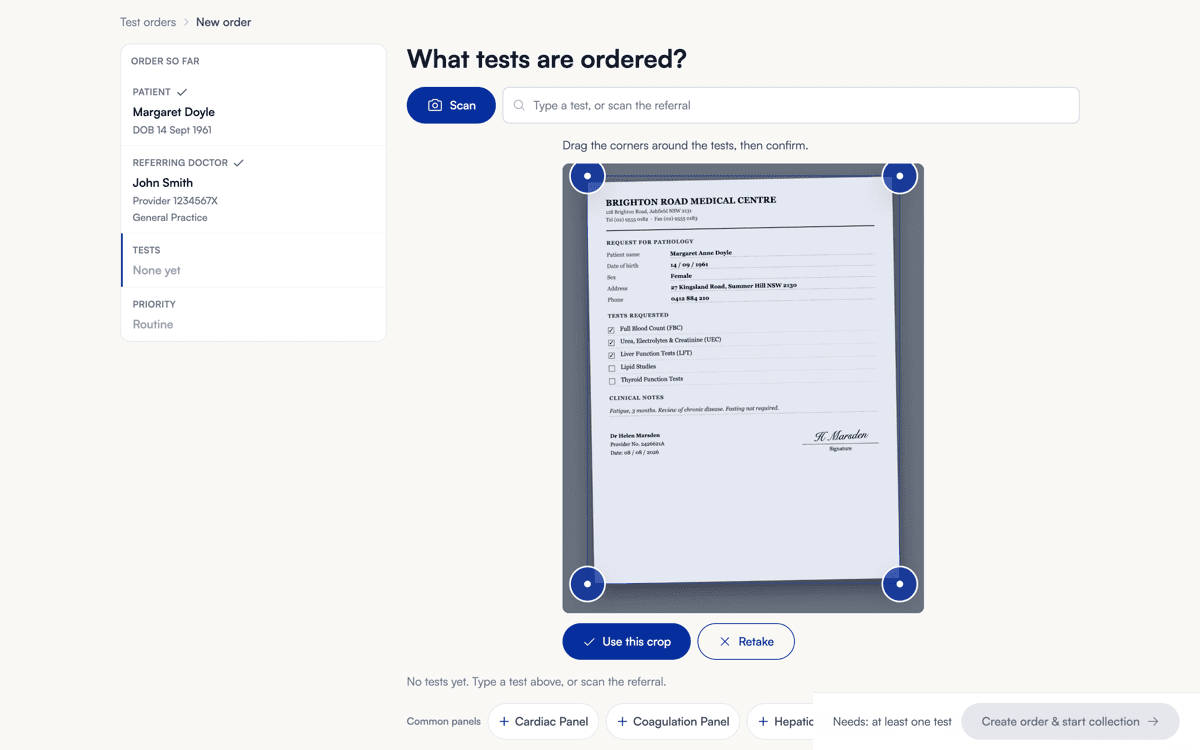
Photograph a paper referral. Get a verified order.
AI extracts the patient, tests and provider from a photographed referral. Your team verifies by exception, confirming what the model read rather than re-keying it.
Provider numbers are validated against the Services Australia checksum before an order is created.
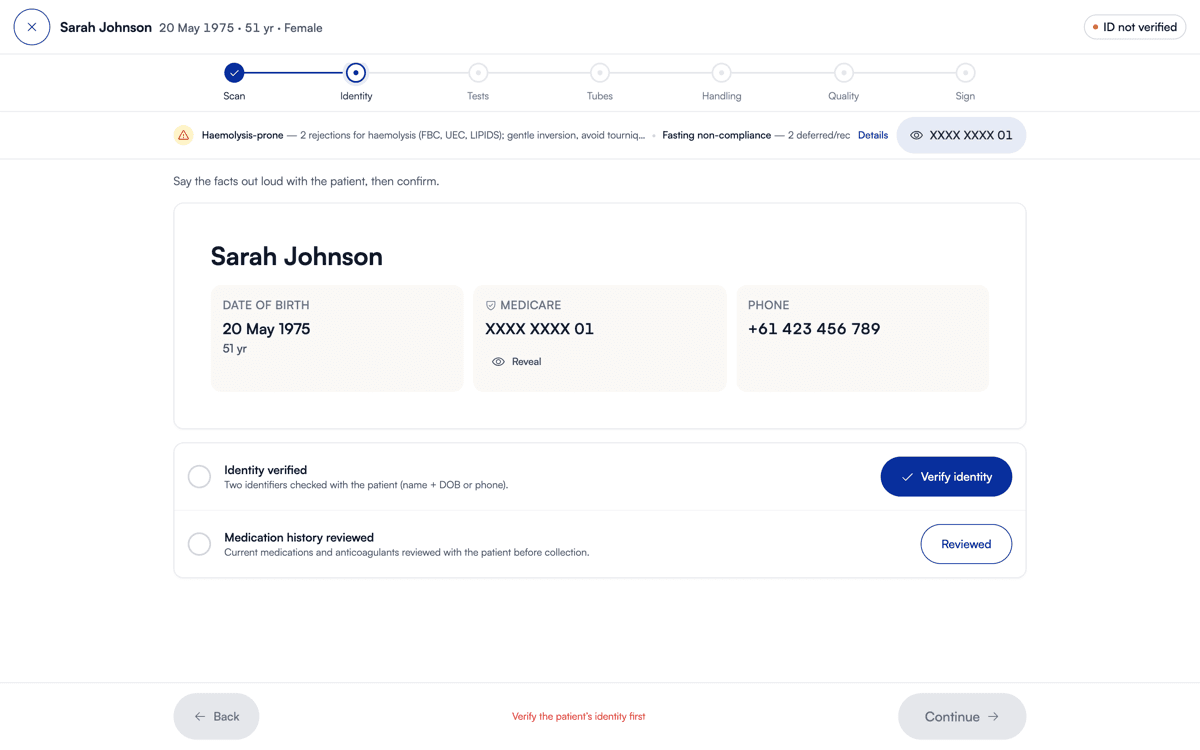
A guided bench that enforces the process.
Patient identity is verified before every collection, a control designed to prevent wrong-patient events. The bench presents a CLSI order-of-draw tube plan, fasting and handling flags, and deferral and exception capture.
Every collection closes with a 9-point NPAAC quality checklist, recorded on the order, plus timestamped photographic evidence. Built for gloved hands and tablets.
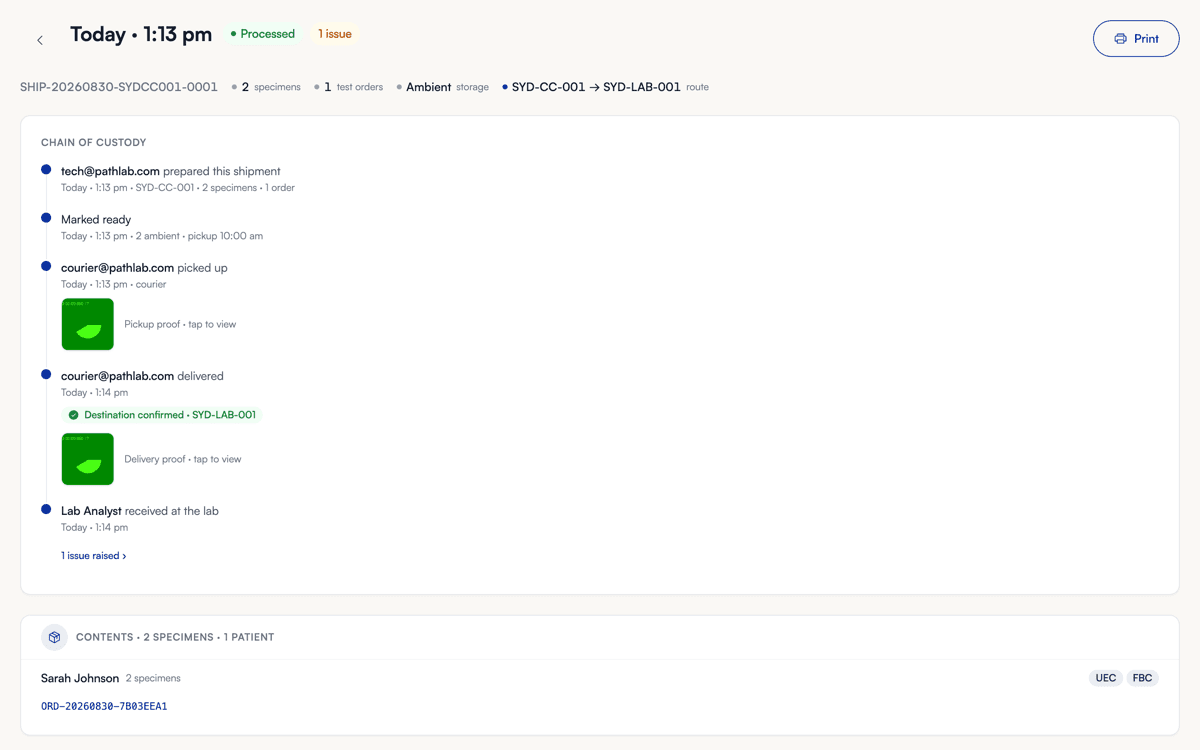
Per-tube tracking from draw to lab receipt.
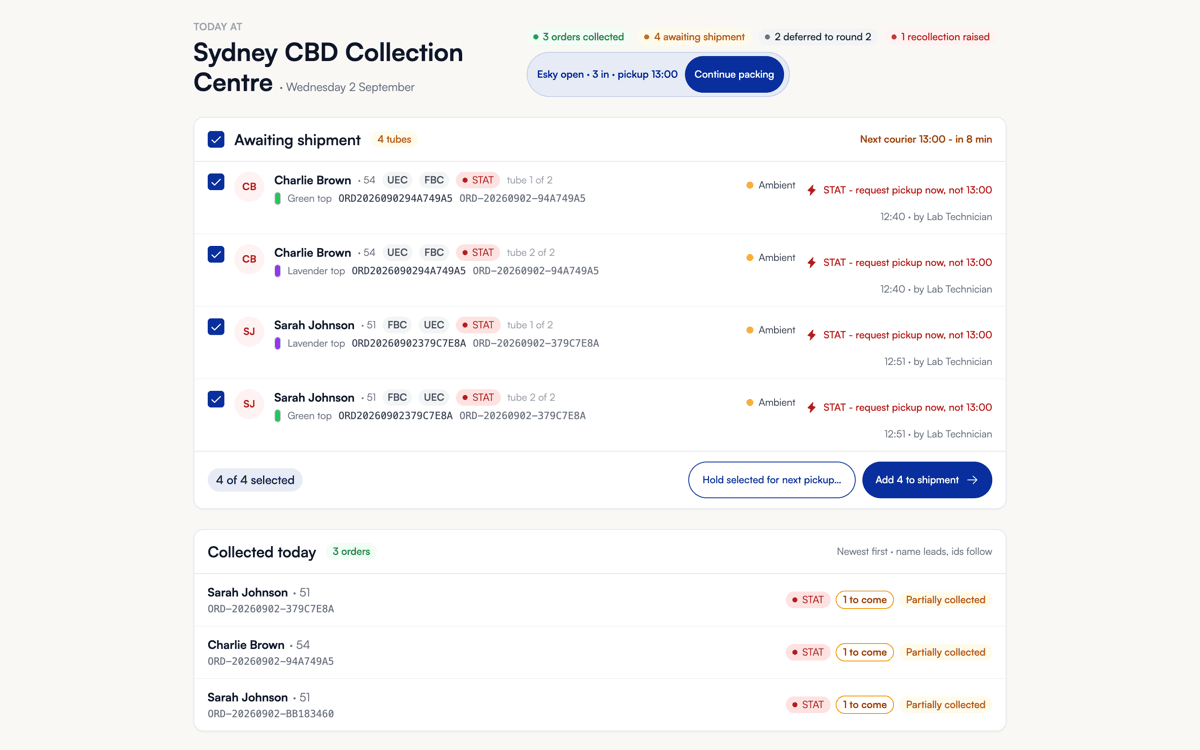
Every tube is tracked through shipment to lab receipt, with split-order “to follow” semantics for specimens that travel separately.
STAT work is escalated the moment it's flagged, so urgent specimens never queue behind routine ones.
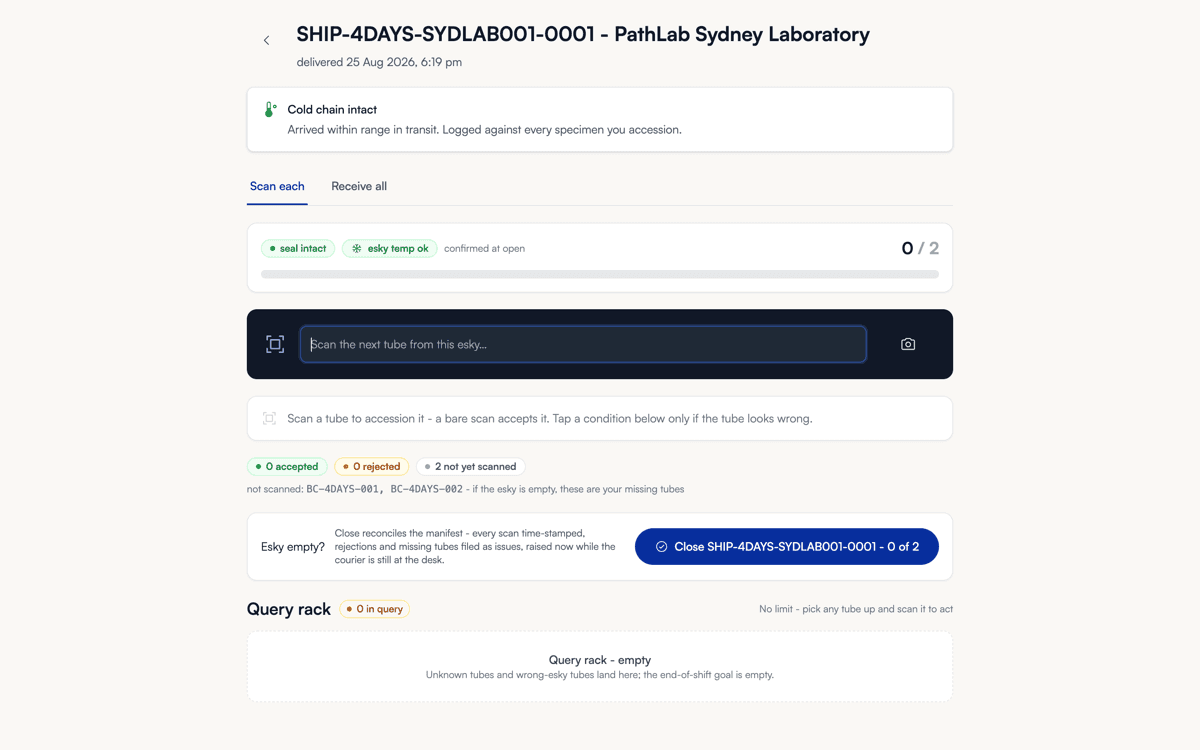
One esky at a time, with commodity scanners.
Reception scans an esky at a time with standard USB barcode scanners. Accept or reject with reason capture, route queries to a query rack and issue automatic receipts.
Rejections feed a recollection dispatch board with patient-contact logging, so nothing silently disappears between the bench and the lab.
Run every site from one place.
Multi-site management with check-in and check-out, pre-shift safety checklists, rosters, handover notes and courier scheduling.
The facility day-ledger shows “today at this facility”: who's on, what's collected, what's waiting on a courier.
Incidents with real root-cause discipline.
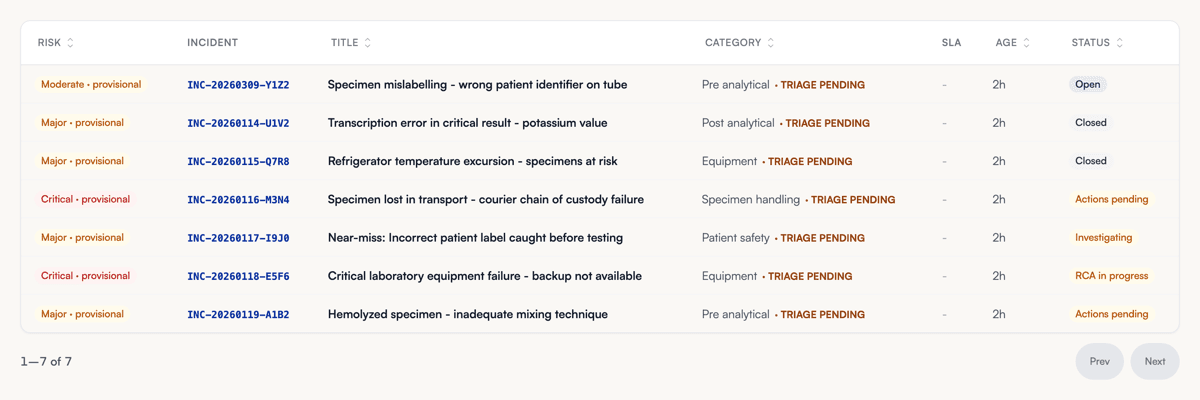
An incident register with risk grading, so what matters is triaged rather than queued. Root cause is worked through structured 5-Whys and Fishbone rather than a free-text box, and corrective actions are tracked to closure.
Operational issues that are not incidents live beside them, so a site is not forced to escalate a scheduling problem to raise it.
PathLab Assist stops at the lab door.
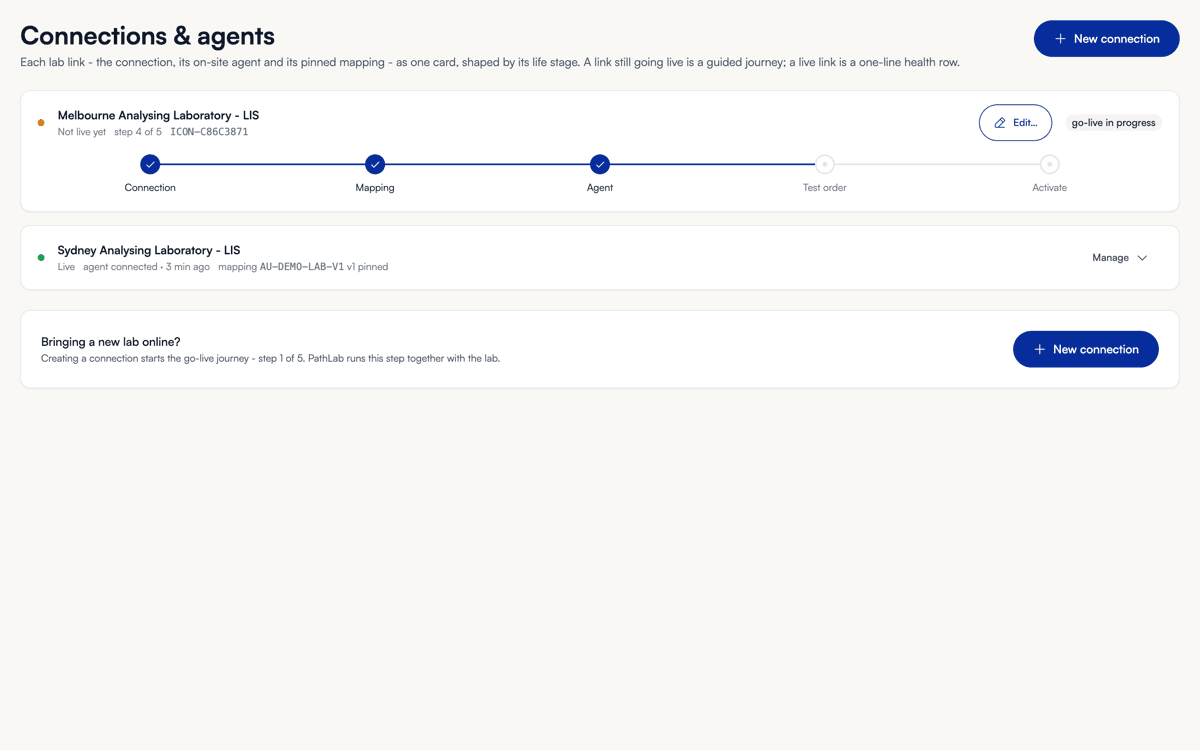
Each lab link is one card, shaped by its life stage: a connection still going live reads as a guided journey, a live one as a single health row.
Bringing a lab online is a five-step go-live run with them, from terminology mapping through agent registration to activation. Nothing transmits until that run completes.
the handover
The order crosses one boundary, outbound only.
Nothing opens inward
The Exchange agent sits on the lab's network and dials out to collect work. There is no inbound firewall rule to open, and no listening port on the lab side.
Fail-closed on mapping
Terminology mapping is versioned and approved before it is used. If a single test in an order is unmapped, the whole order is held for review. A partial order is never transmitted.
Results stay in the LIS
The order is delivered as an HL7 v2.5.1 message and the lab's acknowledgement comes back. Results are never handled on our side.
Every step above it is already evidenced: 190+ audit event types across 24 categories record what happened before the order ever reaches this boundary.
See it with your own workflows.
Everything you just walked through is in the product today. A discovery call walks it through against how your network runs.
Book a discovery call